


Climate change
Climate change is among the key global challenges, with a substantial impact on the activities of the Fund and its portfolio companies, which operate in virtually every sector of Kazakhstan's economy.
Kazakhstan has adopted the Strategy for Achieving Carbon Neutrality by 2060 and has set a target of reducing greenhouse-gas emissions by 15% by 2030 against the 1990 level. Our activities are fully aligned with these national goals.
We have voluntarily chosen the most ambitious "Deep Decarbonisation" scenario and are shaping investment and operational decisions in line with a trajectory of limiting global warming to 1.5°C.
Climate risk management is embedded in the Fund Group's corporate risk-management system and is taken into account in investment and operational decisions.
This approach allows the potential impact of climate factors on asset value, the cost structure and access to financing to be assessed (more details in the "Risk Management" section and in the "Key Climate Risks" Annex).
The basis of our climate strategy is the Low Carbon Development Concept of Samruk-Kazyna JSC (LCDC), approved by the Board of Directors in 2022. The Concept sets out the vision, goals and key directions for the transition to a low-carbon business model up to 2060.
Strategic target — reduction of the Fund Group's carbon footprint by 10% by 2032 vs. the 2021 level (baseline — 72.24 million tonnes CO₂-eq.).
tonnes CO₂-eq.

Alternative
energy
- Renewable energy sources
- Nuclear energy
- Hydrogen energy
- Coal-to-gas switching
- Other low-carbon generation
Resource efficiency and GHG
emissions management technologies
- Clean coal technologies
- Resource and energy efficiency
- Carbon capture and storage
- Offsets (carbon farms and offset projects)
Infrastructure
and regulation
- Modernisation of the NES and Smart Grid roll-out
- Energy storage and accumulation systems
- Flexible generation
- Green transport
Effective management
of the carbon footprint
- Carbon-footprint accounting and reporting
- Digitalisation
- Corporate environmental culture
- ESG in relations with partners and suppliers
- “Green” finance
Greenhouse-gas emissions management
The greenhouse-gas emissions management system in the Group is built on a full-cycle basis and includes the inventory of sources, accounting, monitoring, the delivery of emissions-reduction measures and the preparation of reporting.
Every year we account for quota-bearing installations within the state regulatory system for greenhouse-gas emissions. Direct greenhouse-gas emissions are calculated in accordance with the requirements of Order No. 9 of the Minister of Ecology and Natural Resources of the Republic of Kazakhstan dated 17 January 2023 "On the approval of methodologies for calculating greenhouse-gas emissions and removals". In addition, the approaches to accounting and reporting are shaped with reference to international standards and methodologies, including the IPCC 2006 Guidelines and the GHG Protocol (Corporate Standard and Scope 2 Guidance).
Emission allowances are allocated under the national emissions-trading system. The annual inventory results in a report, which serves as the basis for developing and updating emissions-reduction measures.
The Fund Group implements practices for disclosing carbon-footprint information in line with the requirements of CDP and TCFD.
KazMunayGas JSC has submitted a methane emissions inventory report to the United Nations Environment Programme (UNEP), prepared as part of its participation in the Oil and Gas Methane Partnership 2.0 (hereinafter — OGMP 2.0).
NC QazaqGaz JSC has also joined the OGMP 2.0.
The implementation of the Transition Plan for the low-carbon business model supports the systematic reduction of the Group's carbon footprint in line with the strategic goal of reducing emissions relative to the 2021 baseline. In 2025, the Fund reduced gross greenhouse-gas emissions by 14.5% compared with 2021 (to 61.9 million tonnes CO₂-eq.)
Greenhouse-gas emissions in 202526, million tonnes CO₂-eq.
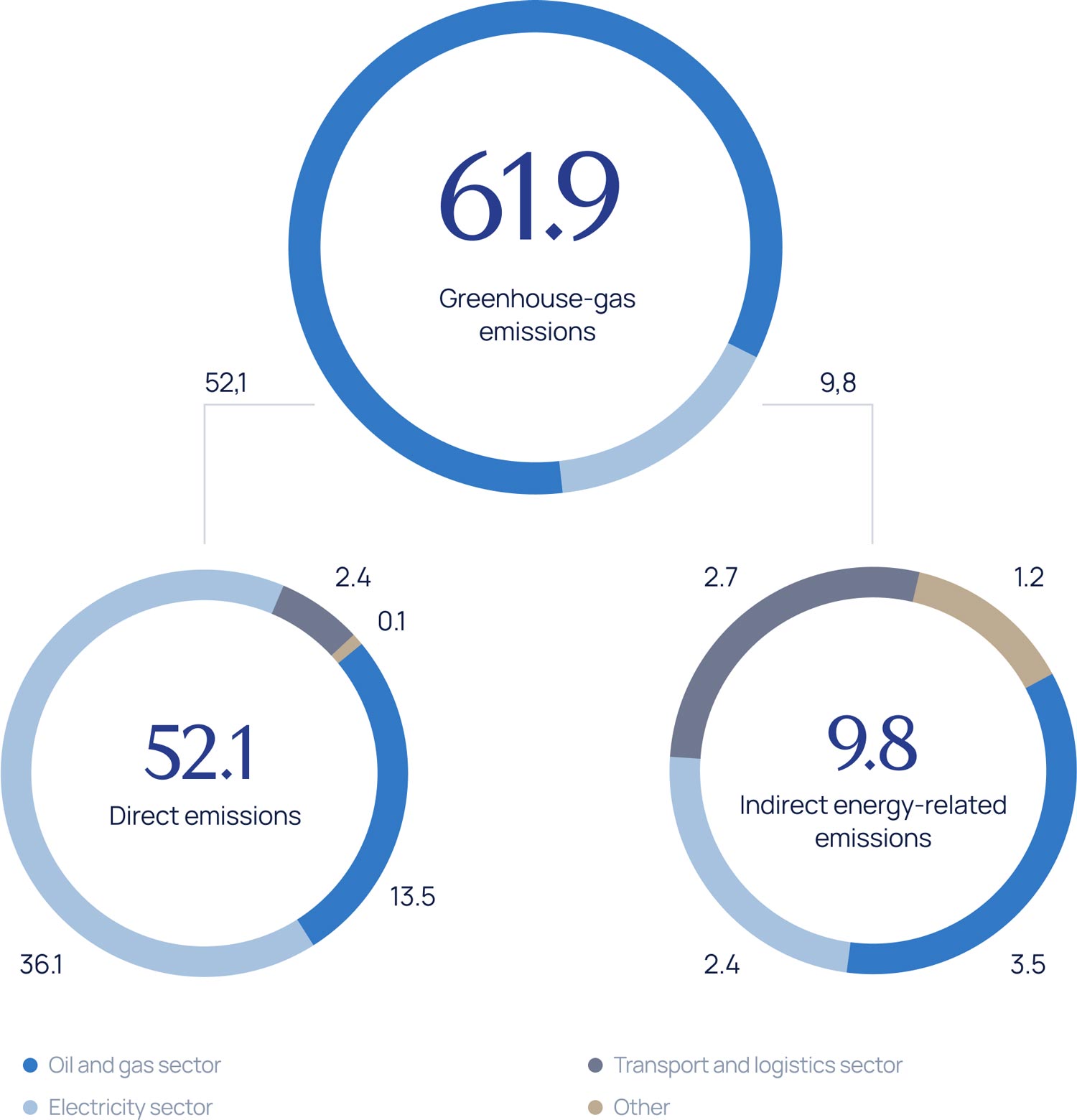
- Greenhouse gas emissions were calculated using global warming potential (GWP) values in accordance with the Sixth Assessment Report of the Intergovernmental Panel on Climate Change (IPCC).
Greenhouse-gas emission intensity (direct and indirect energy-related) per revenue, tonnes CO₂-eq./KZT million
| Indicator | 2023 | 2024 | 2025 |
|---|---|---|---|
| Carbon intensity | 3.8 | 3.5 | 3.3 |
The Group's greenhouse-gas emissions are dominated by direct emissions — 84%, driven by the sectoral structure and the significant share of assets with their own fuel combustion and process emissions. The dominant greenhouse gas is carbon dioxide (CO₂), which accounts for 92% of total emissions.
Direct greenhouse gas emissions by business segment are distributed as follows:
69% — the electricity sector (emissions from the combustion of fossil fuels in power generation);
26% — oil and gas sector (emissions from the combustion of fuel at production facilities involved in the extraction, processing and transport of hydrocarbon raw materials);
5% — other sectors (transport and logistics, mining and metallurgy, petrochemical and chemical, telecommunications).
Within the structure of indirect energy emissions, the largest share is accounted for by the consumption of purchased electricity — 8.9 million tonnes of CO₂-eq, whilst emissions associated with the consumption of thermal energy amount to 0.73 million tonnes of CO₂-eq. The key sources are rail transport and the oil and gas sector, which are characterised by high levels of energy consumption to support transport infrastructure and production processes in extraction and processing.
Greenhouse-gas emission reduction effect in 2025
Measures that supported the reduction of direct emissions
- In the electricity sector the number of incidents involving SF₆ circuit breakers was reduced and preventive maintenance was carried out.
- In the transport and logistics sector fuel and energy consumption was reduced, the locomotive fleet was renewed and rolling stock, lighting and heating systems were modernised. In addition, fuel consumption has been reduced through the introduction of a centralised fuel dispensing system, daily GPS monitoring of fuel consumption by vehicles, monthly comparative analysis of fuel consumption against actual mileage, and the purchase of 83 EURO-5 compliant vehicles.

Measures that supported the reduction of indirect emissions
- In the electricity sector consumption of purchased electricity for own needs was reduced.
During the reporting period we deployed a digital tool for managing associated petroleum gas processing, including a digital twin and a predictive neural-network module integrated with operational systems. The solution optimises equipment operating modes close to real time and forecasts process-parameter deviations before they actually occur. By stabilizing processes and reducing the number of off-design modes, the solution cuts process gas losses, including emissions from venting and emergency shutdowns.
CO₂-eq.
CO₂-eq.