


Artificial Intelligence as a Strategic Tool
Our activities in digitalisation and artificial-intelligence development are guided by the priorities of the Republic of Kazakhstan. The Concept for the Development of Artificial Intelligence for 2024–2029 and the Law "On Artificial Intelligence" have established the legal framework for technology development and set the direction for the Fund in terms of infrastructure development, capability building and the practical adoption of AI in management and operational processes.
Under the Fund's 2023–2032 Strategy, digitalisation and the adoption of advanced technologies are key drivers of asset-value growth and competitiveness. Within this model, artificial intelligence serves as a practical tool for delivering the Fund's strategic goals.
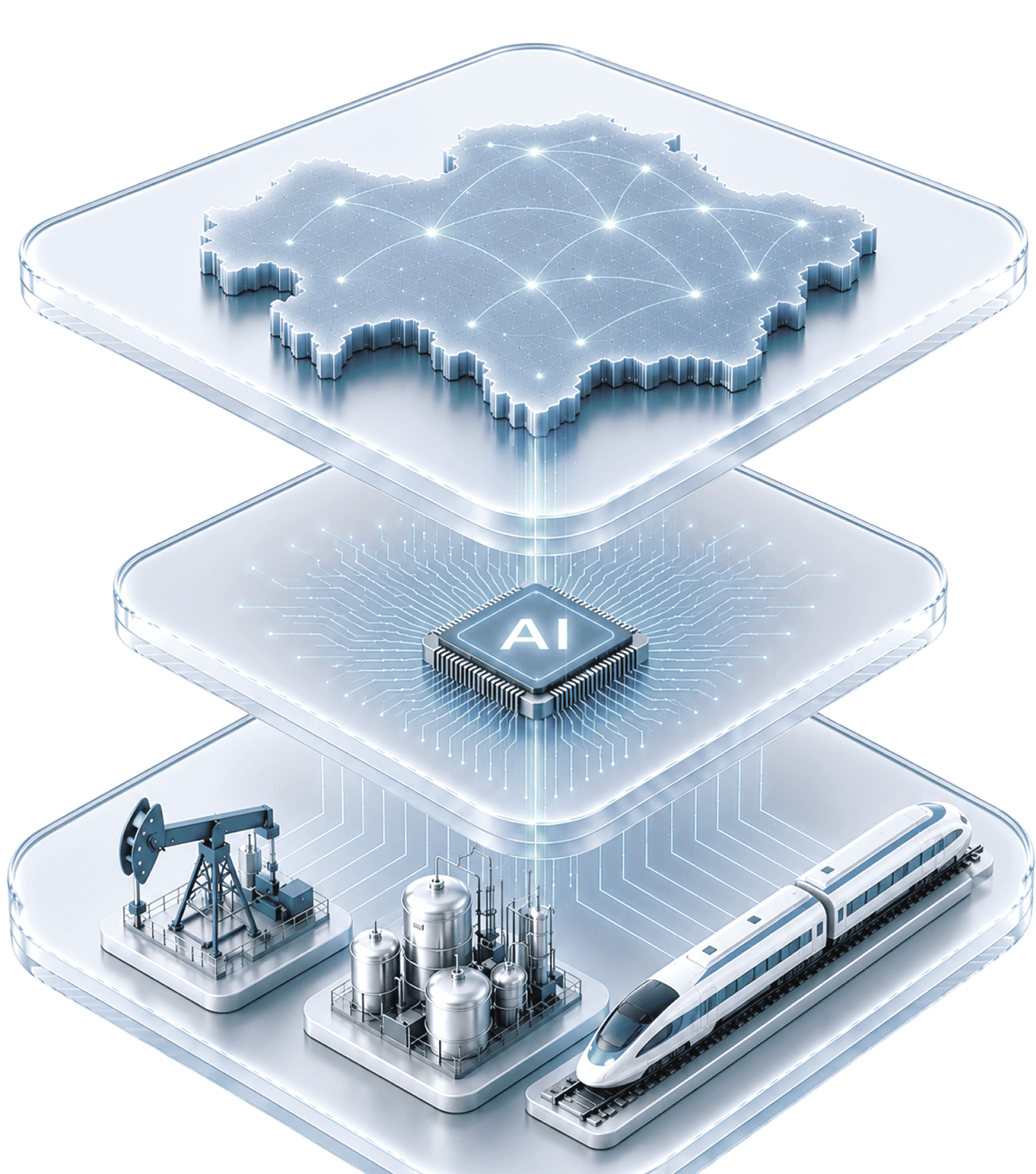
In 2025, the Fund moved from delivering pilot projects to the systematic adoption of artificial-intelligence solutions. AI is now integrated at three levels of activity:
National –
through participation in the development of Kazakhstan's sovereign computing infrastructure
Corporate –
through the adoption of AI in management, compliance and HR processes
Operational –
through the implementation of AI solutions in operational activities

National
level
Al-Farabium: a national framework for the development of AI
We are developing our own computing infrastructure for training and applying artificial-intelligence models in Kazakhstan. One of its key elements is AI-Farabium – the second most powerful supercomputer in Central Asia, ranked 103rd in the global TOP500 list.
On AI-Farabium, the SKAI system has been deployed, and industry-specific AI models are under development for oil and gas, energy and transport.
The infrastructure is currently used by several Group companies and external users:
- KEGOC JSC — for modelling power-system operating regimes;
- NAC Kazatomprom JSC — for optimising production processes;
- Kazakhtelecom JSC — for developing the AI Mektep services;
- with Kazakhstan’s startups and technology companies.


Corporate
level
SKAI: AI at the heart of management decisions
At the corporate level, the SKAI platform plays an important role: since September 2025 it has been used in the work of the Board of Directors. The platform analyses the history of decisions since 2008, as well as information across the entire investment portfolio, improving quality of analytics and ensuring continuity in management decision-making.
We are also developing AI agents6 as a practical tool for optimising business processes. More than 35 agents are currently in operation, covering HR, finance, procurement, legal support, investment activity, social policy and production safety.
These solutions are integrated into a single platform – "SKAI Assistant" – which provides access to data and supports management decision-making. From 2026, they will be scaled across portfolio companies, with a target of up to 70% of decisions taken with AI support within two years.
- An AI Agent is a digital assistant powered by artificial intelligence that independently executes tasks, analyzes data, and supports decision-making within specified business processes.

Operational
level
AI projects in operational activities
At the operational level we are implementing AI projects in the oil and gas, electric power, telecommunications, transport and logistics, and mining and metallurgy sectors. They are aimed at raising the productivity of industrial processes, reducing downtime and incidents, developing client and government services, and reducing workplace injuries.
ABAI: Artificial intelligence in the oil and gas sector
ABAI (Advanced Base and Artificial Intelligence) is a domestic information system designed to optimise oil exploration and production using big-data and artificial-intelligence technologies.
More information on our AI projects and their outcomes is available in the "Our People", "Environmental Impact Management" sections.
Based on 2025 results, the system has delivered:

AI projects by sector

- Increase in oil production of 12,000 tonnes and an economic effect of KZT 1.5 billion in 2025
- 95% reduction in the time required to prepare waterflooding decisions⁷
- KZT 450 million in savings
- Economic effect by 2030 – KZT 326 billion
- Prevention of local fuel shortages
- Reduction of the risk of emergency situations
- Economic effect by 2030 – KZT 22.5 billion
- Potential savings – KZT 34 billion

- Efficient distribution of energy
- Reduced probability of accidents
- Optimisation of generation-capacity loading
- Economic effect by 2030 – KZT 36 billion

- Up to 50% reduction in time for rock-sample analysis
- Up to 25% reduction in the share of inaccurate analyses

- Automation and improvement of government-service management
- Reduction of accident rates by up to 20%
- Up to 50% reduction in network-infrastructure repair costs

- 30% increase in the accuracy of train schedules
- Multiplier economic impact – KZT 31 billion per year (from 2027)
- 15% reduction in mileage
- Up to 97% improvement in delivery punctuality
- 40% acceleration of parcel processing
- Sorting error rate reduced to 0.5%.
- Waterflooding is a technology where water is injected into a reservoir to increase oil recovery. This process requires precise calculations and continuous monitoring.