


Water resources management
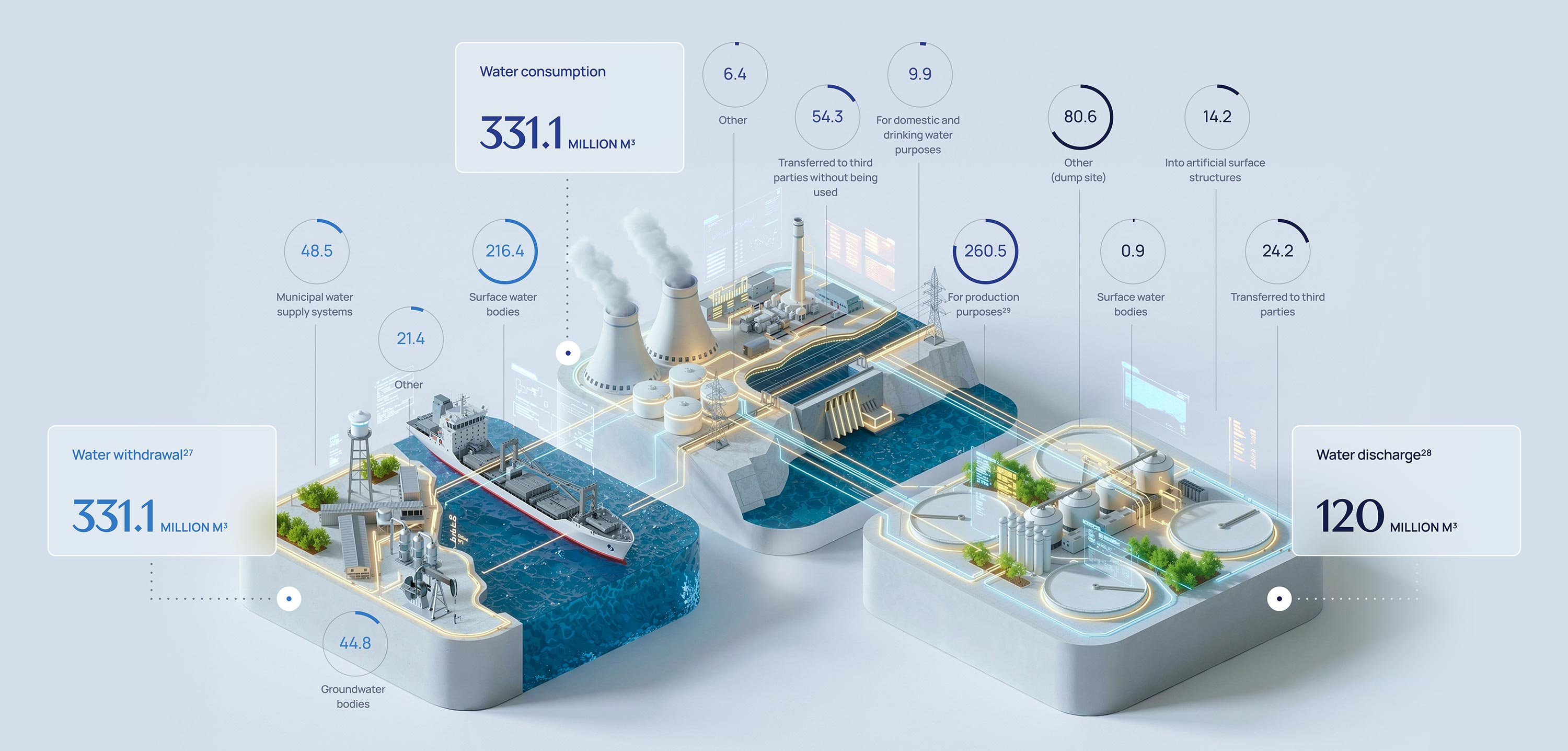
Fund's water balance for 2025, million m³
Kazakhstan is among the countries facing critically high-water scarcity. According to the WRI Aqueduct methodology, the basins of the Caspian and Aral Seas, Lake Balkhash, and the Syr Darya and Ural rivers are classified as areas of high and extremely high-water stress. a significant share of our production assets is in these regions, including oil production, oil refining, uranium mining and coal-fired generation. Reduced water availability is an operational, regulatory and reputational risk for the Fund.
We manage water resources in accordance with the Water Code and the Environmental Code of the Republic of Kazakhstan, water-use permits, and the internal policies and standards of portfolio companies. At the Fund level, we coordinate the water agenda through the Energy and Resource Saving Programme until 2027, which provides for the expansion of recirculating water supply systems, reduction of industrial wastewater volumes, installation of metering devices and improvement of treatment quality before discharge. We have integrated water-related matters into the corporate governance system, with relevant indicators included in the KPIs of portfolio-company management.
NC KazMunayGas JSC, the largest water consumer in the Fund Group, is implementing a ten-year Water Resources Management Programme covering water footprint assessment, risk identification and mitigation measures. Since 2018, NC KazMunayGas JSC has had a Corporate Water Resources Management Standard based on eight water principles.
Water withdrawal
The Fund Group withdraws water from four categories of sources: surface water bodies, groundwater aquifers, municipal water supply systems and seawater from the Caspian Sea. Produced formation water extracted during oil production is accounted for separately as a specific technological flow.
Total water abstraction in 2025 amounted to 71,887.2 million m³. Surface water bodies are the main source, accounting for 99.6% of total water withdrawal. The largest volume of surface water withdrawal is attributable to the electricity sector, where water is used for power generation at hydropower plants.
Produced formation water is extracted together with oil as part of a water-oil emulsion. After gravity separation, the treated water is reinjected into the reservoir to maintain reservoir pressure. In 2025, the volume of produced formation water across the Group amounted to 147.4 million m³, all of which was reinjected into the reservoir. This flow is accounted for separately and is not included in production water withdrawal from natural sources.
Total water withdrawal by quality, million m³
| Source | 2023 | 2024 | 2025 |
|---|---|---|---|
| Fresh water | 63,735.1 | 80,236.3 | 71,681.01 |
| Other water (brackish, seawater, groundwater) | 188.7 | 195.4 | 206.1 |
Water withdrawal in water-stressed regions
In accordance with the WRI Aqueduct methodology, we conduct enhanced monitoring of water withdrawal and water consumption in areas of high and extremely high water stress, including the basins of the Caspian and Aral Seas, Lake Balkhash, and the Syr Darya and Ural rivers. These regions host the production assets of NC KazMunayGas JSC, NAC Kazatomprom JSC and Tau-Ken Samruk NMC JSC.
In 2025, total water withdrawal in water-stressed regions decreased by 20% compared with 2024 and amounted to 22.9 million m³. This was driven by a 44.3% reduction in freshwater withdrawal to 6.5 million m³, reflecting targeted efforts to replace freshwater sources with alternative sources.
Water withdrawal in water-stressed regions, million m³
| Indicator | 2023 | 2024 | 2025 |
|---|---|---|---|
| Water abstraction in water-stressed regions30 | 30.2 | 28.5 | 22.9 |
| of which fresh water: | 13.7 | 11.6 | 6.5 |
| of which other water (saltwater, groundwater): | 16.4 | 16.9 | 16.4 |
| Water discharge in water-stressed regions | 3.3 | 3.3 | 3.6 |
| Water consumption in water-stressed regions | 26.8 | 25.2 | 19.3 |
- According to the WRI Aqueduct Baseline Water Stress indicator.
The water bodies from which we withdraw water have significant environmental, economic and social value.
- The only centralized source of drinking water for the city of Zhanaozen and four districts of Mangystau Region;
- KazMunayGas NC JSC has implemented reconstruction works, increasing capacity from 110 to 170 thousand m³/day.
- Growing industrial water abstraction competes with the needs of the local population.
- Regulation of the flow of a transboundary river;
- Irrigation;
- Recreation;
- Fisheries.
- Reduced inflow during low-water years limits hydropower generation;
- The flow of the Ile River is formed in the territory of the PRC; therefore, the inflow volume depends on joint water resource management with the Chinese side.
- Transboundary basin: Aral-Syr Darya Basin;
- Flood protection;
- Irrigation;
- Fisheries.
- High water stress according to WRI Aqueduct;
- Regulation of water release regimes is coordinated with water management authorities.
- Unique ecosystem;
- Sturgeon spawning grounds;
- High cultural value.
- Poaching and changes in the hydrological regime lead to a decline in spawning stocks;
- Regulation of the Ural River flow requires coordination with neighbouring states; water withdrawal for irrigation reduces low-water flow.
- Regulation of the flow of a transboundary river;
- Flood prevention;
- Water supply to East Kazakhstan Region.
- Transboundary use: the Irtysh River flows through the territories of the PRC, the Republic of Kazakhstan and the Russian Federation; the inflow volume depends on water abstraction in the PRC;
- The Semipalatinsk HPP, with a capacity of 350 MW, is at the design stage and will complement the cascade.
Water discharge
Total water discharge for the reporting period amounted to 71,671.7 million m³, of which hydropower plant (HPP) discharge accounted for 71,407.8 million m³. Water discharge from the Fund's production companies not related to electricity generation was approximately 120 million m³. Water discharged by HPPs for electricity generation totalled 71,407.8 million m³ (99.6% of total water discharge).
In addition, JSC NC KazMunayGas provides fresh process water supply services to consumers in Atyrau and Mangistau regions. In 2025, 21.99 million m³ were supplied to external customers, excluding volumes used for internal purposes.
In the power generation sector, 80.6 million m³ of water was used for the discharge of ash and slag waste through hydraulic ash removal (HAR) systems. a further 14.2 million m³ was discharged into artificial water bodies (evaporation ponds, retention ponds, and filtration fields). Discharge into surface water bodies (0.97 million m³) includes stormwater runoff from industrial sites and water not involved in the technological process.
No industrial wastewater is discharged into surface water bodies.
All wastewater undergoes treatment to meet regulatory quality standards prior to discharge. Treatment methods applied include mechanical, physico-chemical (oil traps, flotation units, etc.), and biological processes. a mandatory prerequisite is preliminary laboratory quality control of wastewater conducted by accredited laboratories.
Based on 2025 results, no violations of established pollutant concentration standards in wastewater were recorded.

Water consumption
The energy sector (electricity and heat generation) accounts for the largest share of water consumption — 99%. Total consumptive water use in 2025 amounted to 215.4 million m³, representing a decrease of 7.4% compared with the previous reporting period (232.7 million m³ in 2024).
The largest contributions are made by the power generation sector (evaporation from cooling reservoir surfaces and ash dumps) and the oil and gas sector.
We reduce primary water withdrawal primarily through the expansion of closed-loop water supply systems. At the Ekibastuz GRES thermal power plants, recirculating cooling reservoirs are used for turbine condenser systems.
At the Almaty CHPs, cooling towers are used. The volume of recirculated water grew by 9.1%, equivalent to an approximate reduction of 372 million m³ in primary water withdrawal relative to 2024 levels.
The volume of reused water increased by 21.1% compared with 2024. Treated industrial wastewater is used to replenish fire-fighting systems, irrigate green spaces, and meet technical needs.
Recirculated and reused water, million m³
| Indicator | 2023 | 2024 | 2025 |
|---|---|---|---|
| Volume of reused water (after treatment) | 22.3 | 23.9 | 29.0 |
| Volume of recirculated water | 3,928.4 | 4,077.2 | 4,448.7 |
Key water-use projects
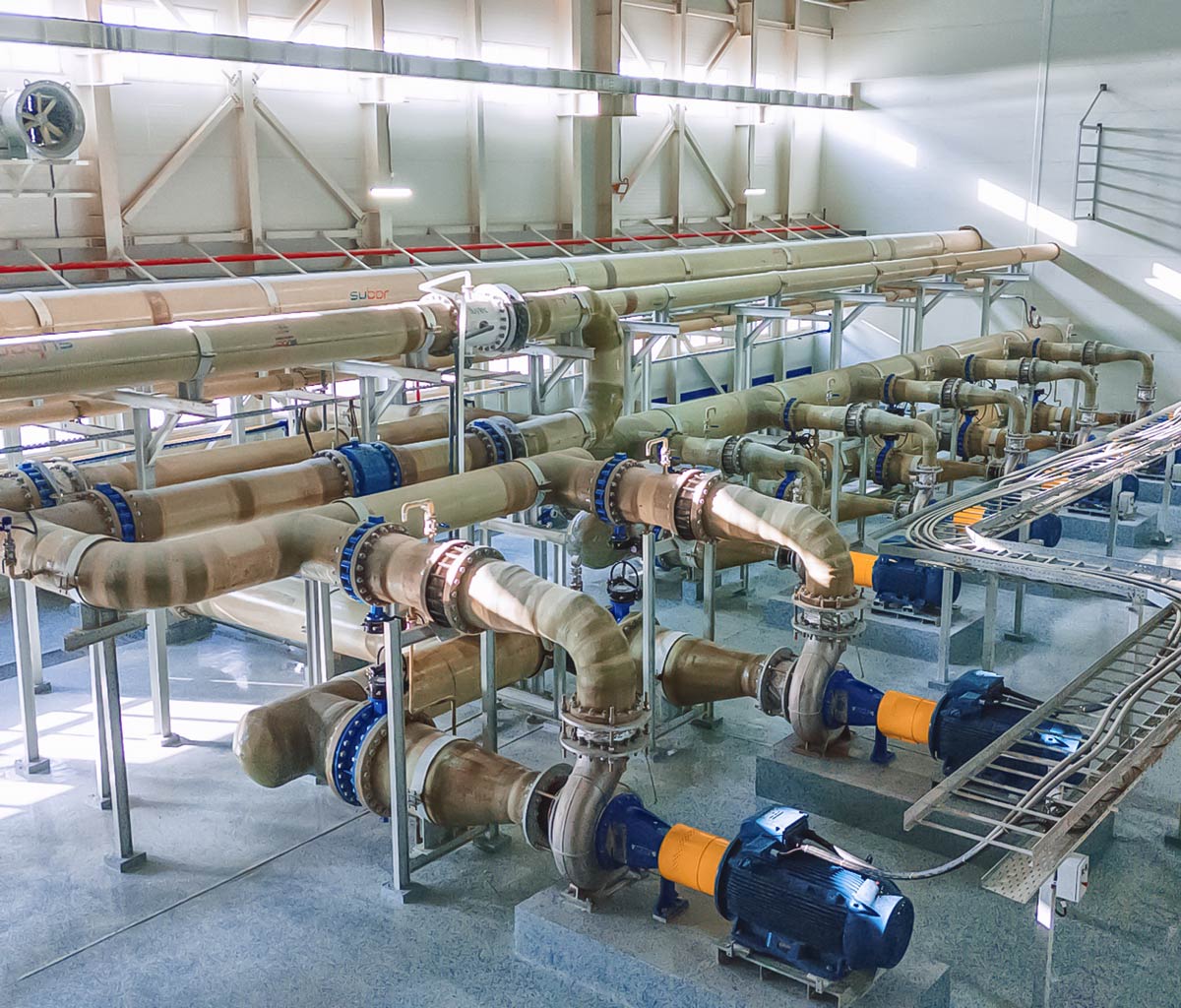
Kenderli desalination plant, NC KazMunayGas JSC
In 2025, NC KazMunayGas JSC completed the construction of a seawater desalination plant near Zhanaozen with a design capacity of 50,000 m³ of drinking water per day.
Effect from delivery projects
The project eliminates the drinking water deficit in Mangystau Region, reduces the load on the only regional water pipeline, Astrakhan-Mangyshlak, and diversifies water supply sources. The project created 91 permanent jobs.
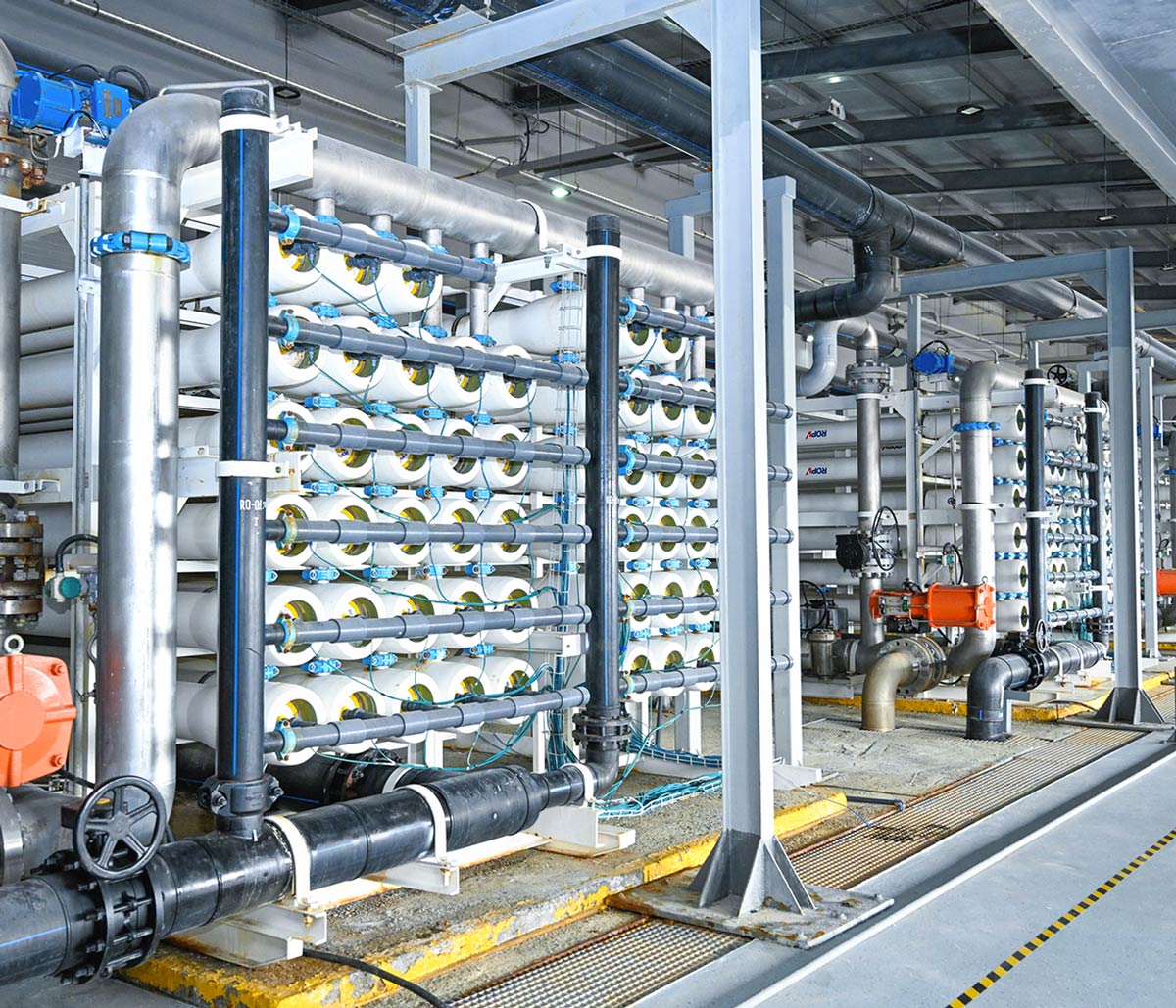
Karazhanbas formation water desalination plant, NC KazMunayGas JSC / Karazhanbasmunay JSC
The facility processes up to 42,500 m³ of formation water per day, producing up to 17,000 m³ of desalinated water for the field’s technical needs.
Effect from delivery projects
This has reduced consumption of Volga water by almost four times, from 21,000 to 5,000 m³ per day.
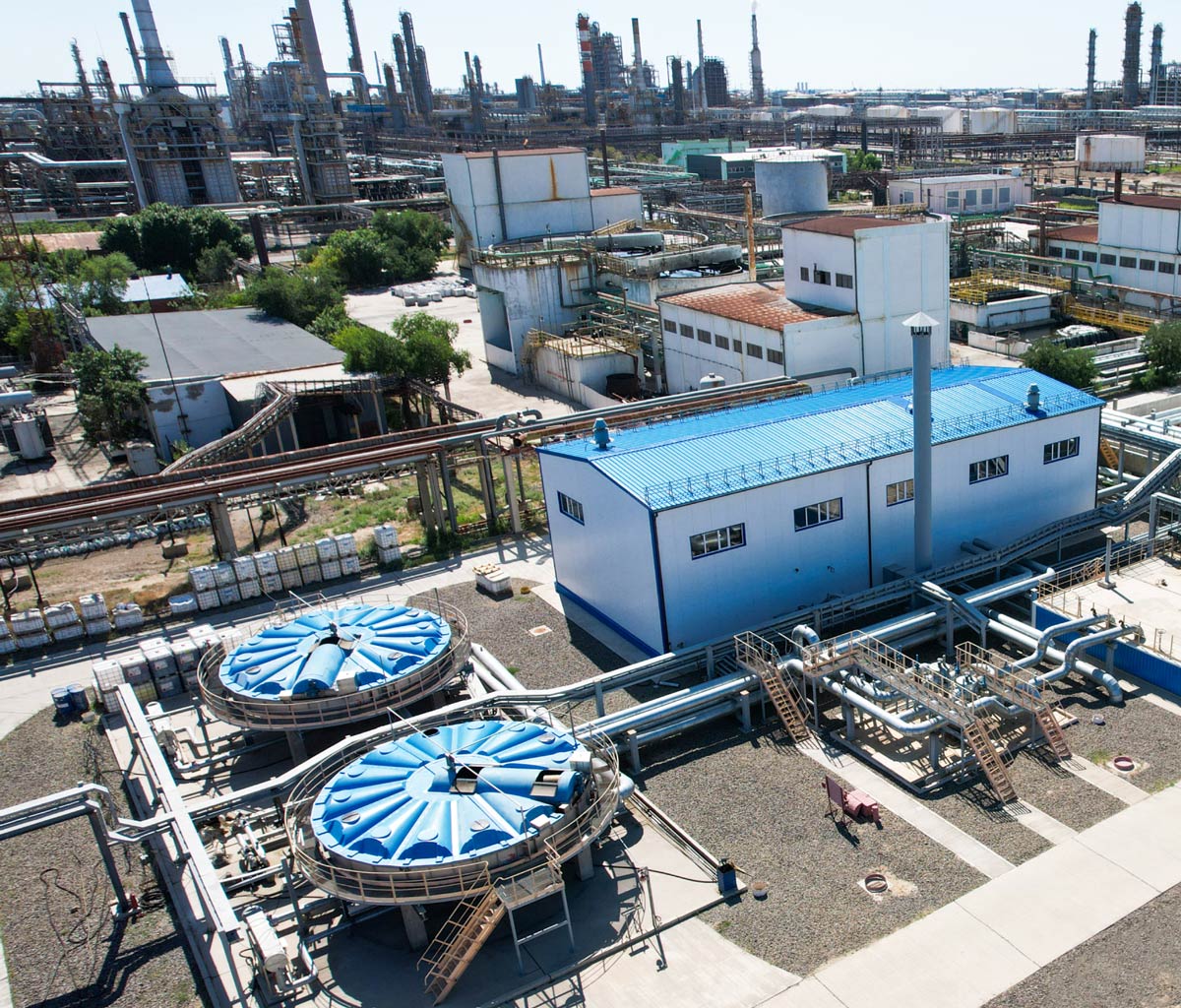
Tazalyq project, Atyrau Refinery, NC KazMunayGas JSC
The project involved the reconstruction of mechanical and biological treatment facilities at Atyrau Refinery. The capacity of the mechanical treatment facilities was increased to 1,000 m³ per hour. Open ponds were eliminated, significantly reducing hydrocarbon evaporation.
Effect from delivery projects
The project was completed in 2024, with its technological effect reflected in the 2025 data.
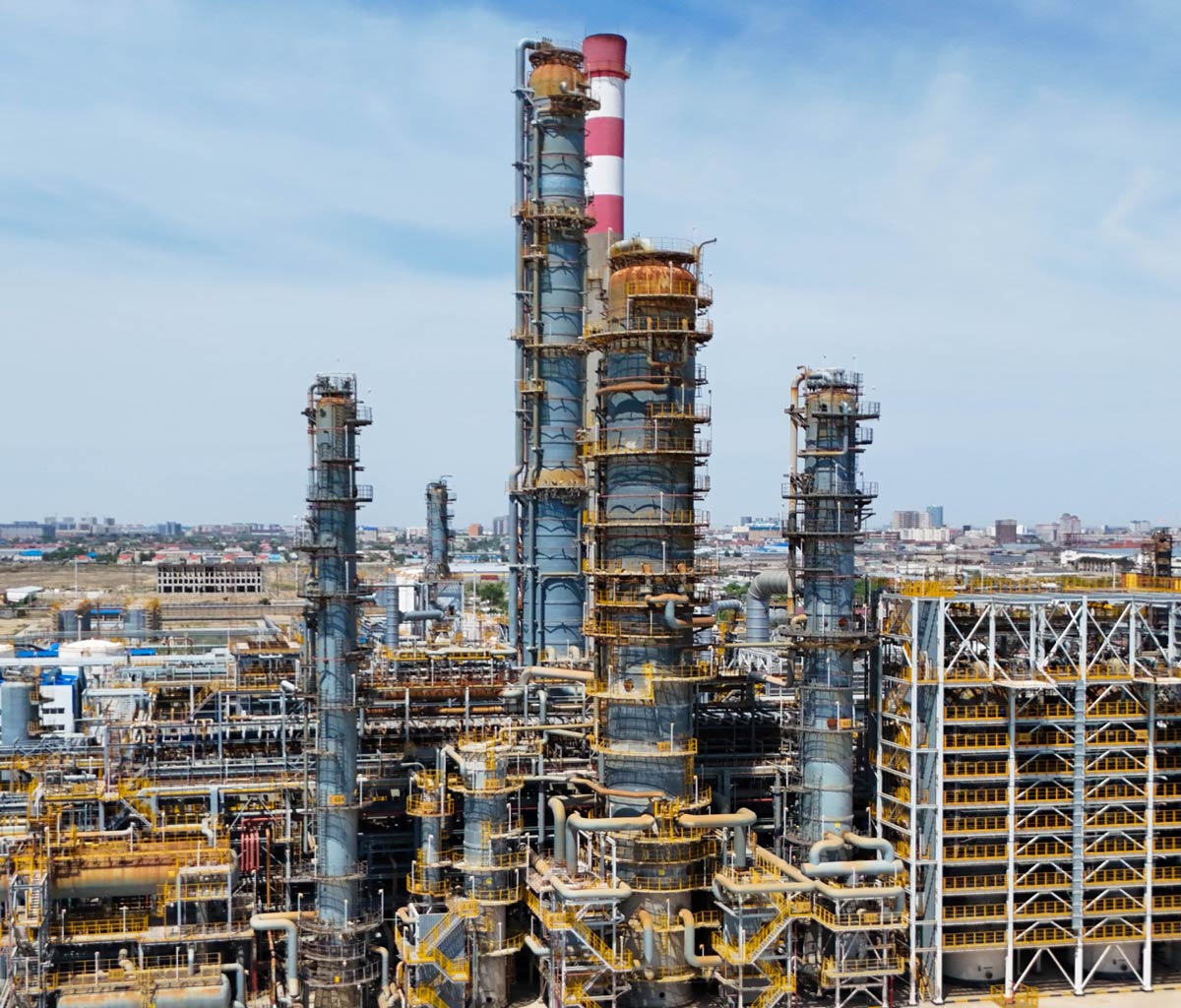
Improving the quality of recirculated water supply at Atyrau Refinery, Samgau CSTI / NC KazMunayGas JSC
The project is aimed at improving water quality in the recirculated water supply system through the use of complex reagents based on activated aluminium.
Effect from delivery projects
A 96% recirculated water stabilisation rate was achieved.