


Economic impact in numbers
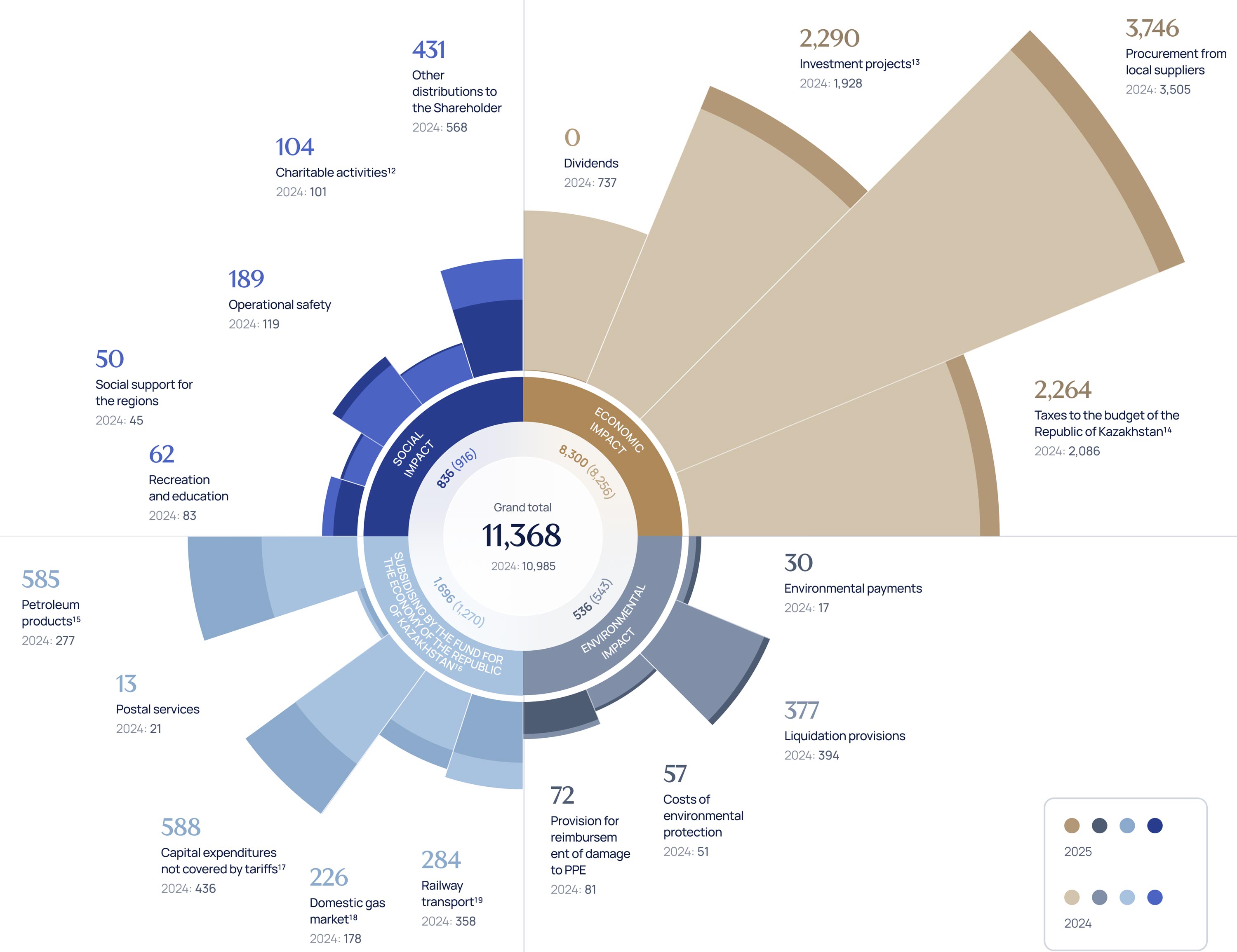
In 2025, we increased tax payments to the state budget by 9% compared with 2024 and significantly raised investment expenditure – by 19% year on year.
The Fund also expanded the scope of economic subsidies, including support for the petroleum-products market, rail transport and the domestic gas market. This helped contain price and tariff growth and ensured the affordability of key goods and services for households and businesses.
Economic impact in numbers, KZT billion
- Including contributions to the Kazakhstan Khalkyna Public Foundation, on an accrual basis.
- Excluding VAT, on an accrual basis.
- Excluding personal income tax.
- Subsidies are expressed in terms of lost profits of oil producers due to the difference between export and regulated domestic prices for crude oil delivered to the domestic market minus export customs duties and transportation (netback).
- Cross-subsidisation by the Fund of socially significant sectors to curb price and tariff increases.
- Capital expenditures not covered by approved tariffs are calculated as the difference between capital expenditures approved by Natural Monopolies Regulation Committee and actual capital expenditures.
- Actual gas purchase and transportation costs exceed revenues at approved tariffs for marketable gas on the domestic market. Thus, the subsidy is revenue less the cost of gas and transport costs.
- The costs approved by the Committee for the Regulation of Natural Monopolies of the Ministry of Energy of the Republic of Kazakhstan (CREM) in the tariff estimates do not cover the actual costs of freight and passenger transportation on intrarepublican communication at the regulated tariffs of JSC National Company Kazakhstan Temir Zholy (“KTZh”) for services of the main railway network and locomotive traction. Accordingly, the subsidy was calculated as the difference between actual costs and the costs of regulated services approved in the tariff estimates.