
Fund’s Contribution to the Economy of the Republic of Kazakhstan
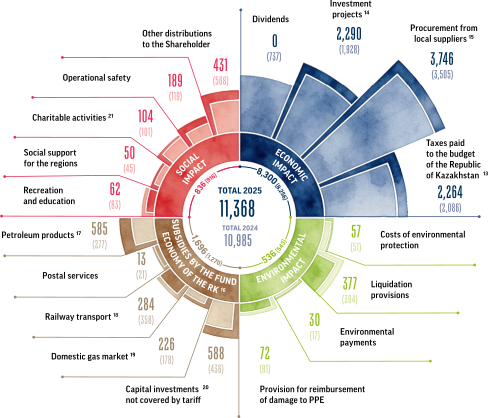
Impact matrix 12, KZT billion

- Within the reporting boundaries of the Sustainability Report and Consolidated Financial Statements for 2025.
- Excluding PIT.
- Excluding VAT, on an accrual basis.
- The category of procurement from local suppliers relates to the annual procurement volume and does not include procurement carried out under long-term contracts.
- Cross-subsidisation by the Socially Important Sphere Fund to curb price and tariff increases.
At the end of 2025, the Fund’s contribution to the country’s sustainable development was estimated at
In 2025, the Fund’s social impact amounted to
In 2025, the contribution to the country’s economic development amounted to
The contribution to environmental sustainability in 2025 amounted to
The Fund’s subsidisation of the economy in 2025 amounted to
Samruk-Kazyna JSC plays a key role in advancing the sustainable economic growth model in the Republic of Kazakhstan. Social responsibility forms an integral component of the Fund’s overall contribution within this framework. In 2025, the Fund’s social impact totalled KZT 836 billion, encompassing expenditures on social initiatives delivered through various channels, including other distributions to the Shareholder, contributions to the Qazaqstan halqyna Public Fund, charitable activities of Samruk-Kazyna Trust, as well as support for employees and communities in regions of operation and measures to ensure occupational safety.
The Fund’s contribution to the state economy amounted to KZT 8,300 billion. Tax payments to the state totalled KZT 2,264 billion12. The Fund invested KZT 2,290 billion in strategically important infrastructure and key economic sectors, including energy, gas infrastructure, transport and communications, as well as exploration and production.
As part of the entrepreneurship support, the Fund procured goods and services worth KZT 3,746 billion from local suppliers.
The environmental contribution amounted to KZT 536 billion, covering both environmental payments and investments in environmental protection measures, including application of technologies, energy efficiency, and R&D activities. The total amount also includes liquidation reserves and environmental remediation, as well as a provision for environmental damage liabilities.
In 2025, the Fund’s cross-subsidization of prices and tariffs totalled KZT 1,696 billion, with profitable operations continuing to offset losses in non-performing segments.
Rail transportation activities were subsidized by KZT 284 billion, financed through transit revenues. The domestic petroleum products market received support of KZT 585 billion funded by other business segments of NC KazMunayGas JSC, including exports. The domestic gas market was compensated by KZT 226 billion primarily through revenues generated from gas transit and export operations.
Moreover, new measures aimed at the tariff policy improvement were implemented in 2025. As a result, regulated rail tariffs increased by approximately 28% cumulatively, while wholesale gas prices rose by 33%. At the same time, the government initiated a gradual deregulation of the fuel and lubricants market.
- Subsidization is expressed as the lost profit of oil-producing companies due to the difference between export and regulated domestic prices for the volume of oil supplied to the domestic market, net of export customs duties and transportation costs (netback).
- Costs approved by the Committee for Regulation of Natural Monopolies of the Ministry of National Economy of the Republic of Kazakhstan (CRNM) in the tariff estimate do not cover the actual costs of freight and passenger transportation in domestic traffic at regulated tariffs of NC Kazakhstan Temir Zholy JSC for main railway network services and locomotive traction. Accordingly, subsidization was calculated as the difference between actual costs and the costs of regulated services approved in the tariff estimate.
- Actual costs for the purchase and transportation of gas exceed revenues under the approved tariffs for commodity gas in the domestic market. Thus, subsidization is defined as revenue minus the cost of gas and transportation expenses.
- Capital investments not covered by approved tariffs are calculated as the difference between capital expenditures approved by the Committee for Regulation of Natural Monopolies of the Ministry of National Economy of the Republic of Kazakhstan and actual capital expenditures.
- Including distributions to the Qazaqstan halqyna Public Fund, on an accrual basis.